
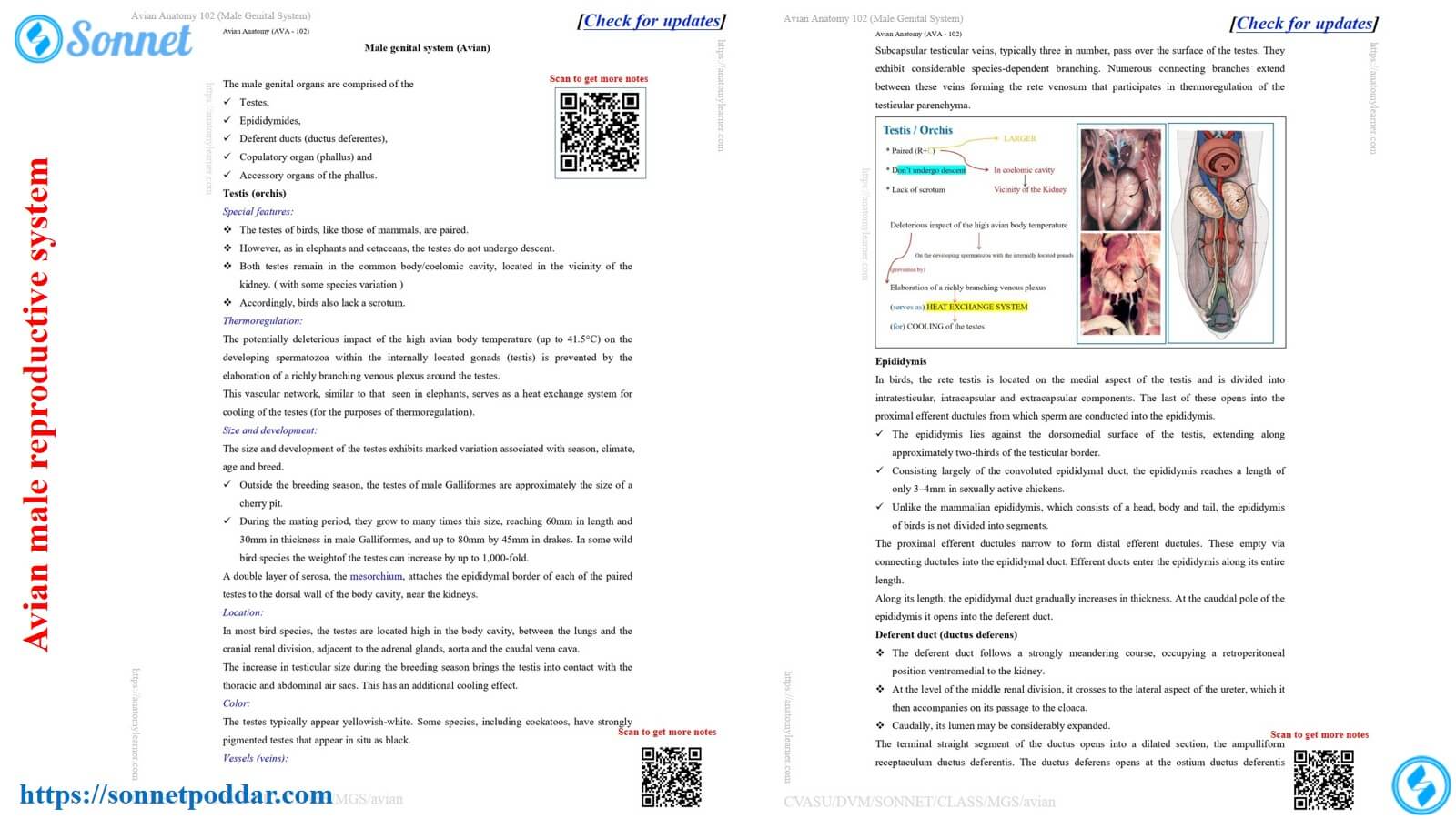
The avian male reproductive organs are comprised of the
- Orchis,
- Epididymides,
- Deferent ducts (ductus deferentes),
- Copulatory organ (phallus) and
- Accessory organs of the phallus.
Here, you will find a concise description of the above-mentioned organs of the avian male reproductive system with diagrams. However, I will provide the notes on the avian male reproductive system.
Avian male reproductive system organs diagram
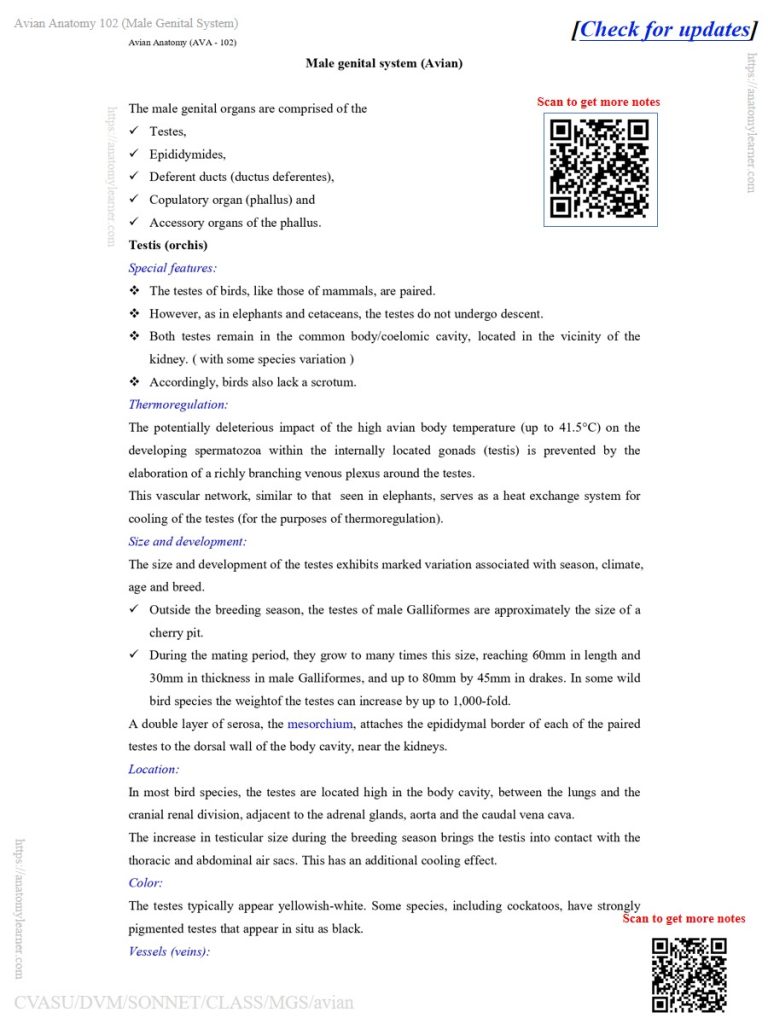
Orchis of the avian male
Special features:
- They are paired, like those of mammals.
- However, they do not undergo descent.
- Both orchis remain in the common body/coelomic cavity, located in the vicinity of the kidney ( with some species variation ).
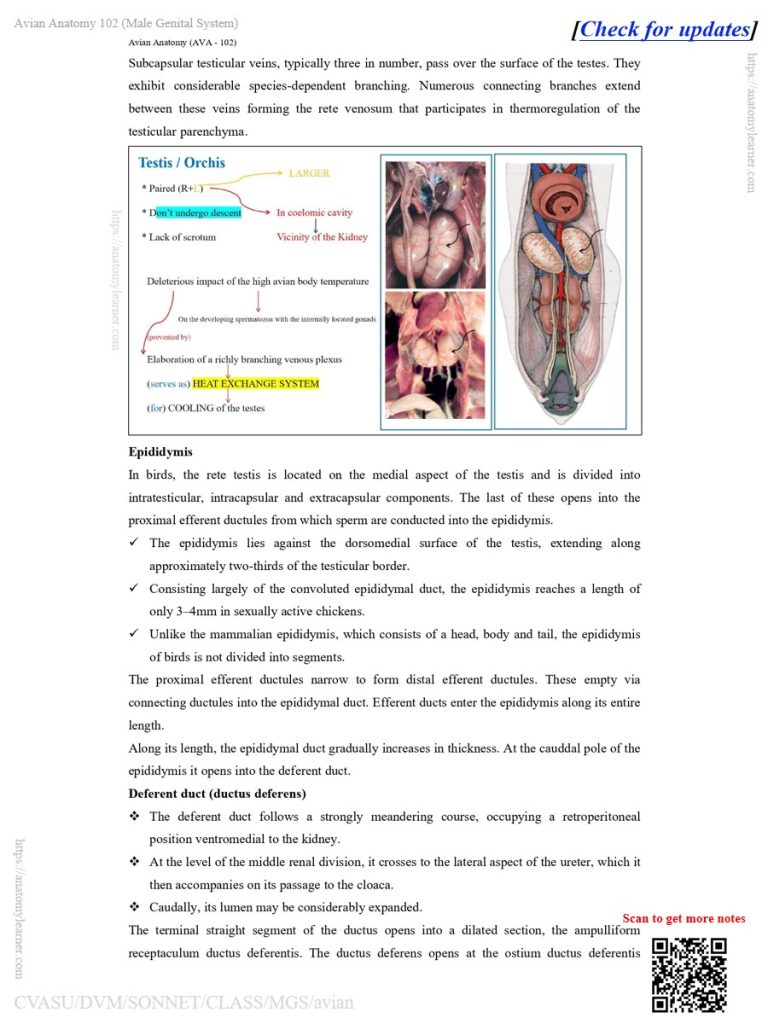
Thermoregulation:
As the orichis remain confined within the body cavity of the avian species. Thus, a deleterious impact of the high avian body temperature on the developing spermatozoa will occur.
But the orchis has the elaboration of a richly branching venous plexus. Thus, the deleterious impact can be prevented by this system. The richly branching venous plexus serves as a heat exchange system for cooling the orchis.
Size and development:
There is a great variation in the size and development of the orchis. This variation is associated with season, climate, age and breed.
- Outside the breeding season: They are approximately the size of a cherry pit.
- During the mating period: They grow to many times this size (up to 1000 times).
Mesorchium: A double layer of serosa that attaches the epididymal border of each of the paired orchis to the dorsal wall of the body cavity, near the kidneys.
Location:
They are located high in the body cavity, between the lungs and the cranial renal division. They also have a relationship to the adrenal glands, aorta and the caudal vena cava.
The increase in testicular size during the breeding season brings the testis into contact with the thoracic and abdominal air sacs.
Color:
They typically appear yellowish-white.
Vessels:
Orchis has the subcapsular testicular veins. They are typically three in number and pass over the surface of the testes. However, they exhibit considerable species-dependent branching.
You will get the summary of the avian orchis in the figure and also in the note.
Epididymis of the avian male
- The epididymis of the avian male lies against the dorsomedial surface of the orichis.
- It extends along approximately two-thirds of the testicular border.
- However, it consists largely of the convoluted epididymal duct.
- The avian male have no head, body, or tail in their epididymis like the mammals.
Here, the epididymal duct gradually increases in thickness. Finally, at the caudal pole of the epididymis, it opens into the deferent duct.
Deferent duct (ductus deferens) of the avian male
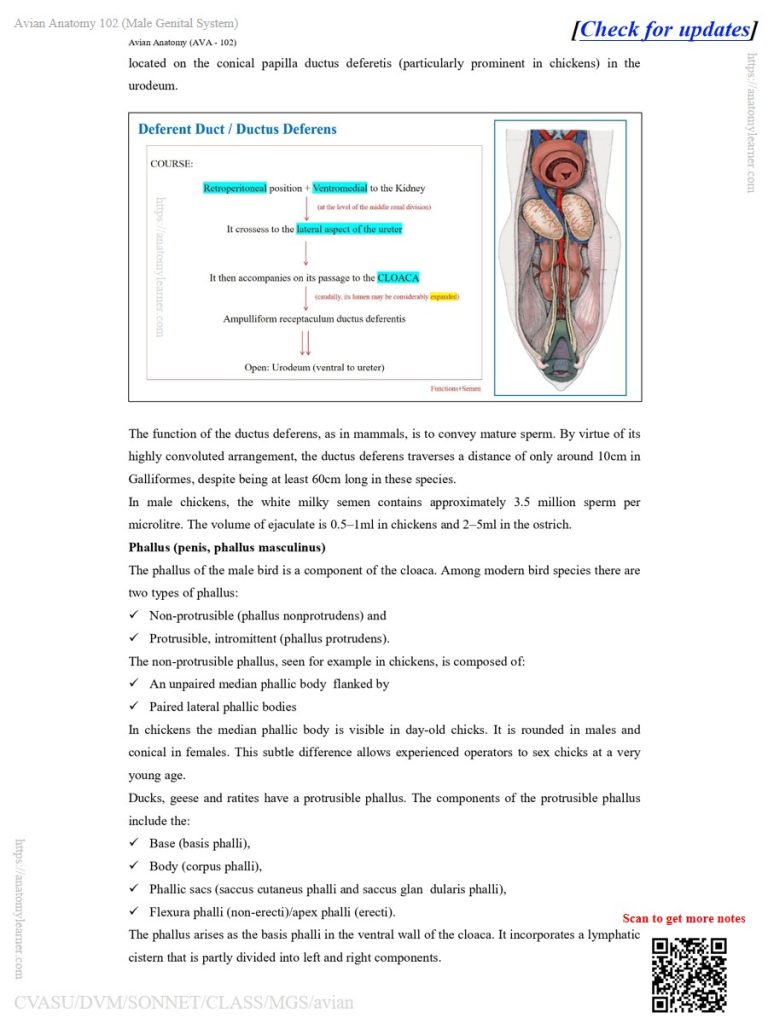
For avian species, you need to learn only the course of the deferent duct/ductus deferens. Here, I have already condensed the course of the avian male’s ductus deferens and provided it in both diagrams and notes.
Summary of the course of the avian ductus deferens: it has a retroperitoneal position ventromedial to the kidney. It crosses to the lateral aspect of the ureter at the level of the middle division of the kidney.
Here, the ductus deferent of the avian male accompanies its passage to the cloaca. It opens on the conical papilla ductus deferetis in the urodeum of the avian species.
You will see a dilated section at the terminal part of the ductus deferens. It is known as the ampulliform receptaculum ductus deferentis
Phallus/phallus masculinus of avian male
Typically, you will find two types of phallus in the avian male. It is one of the main components of the cloaca.
The two types of phallus of avian species are –
- Non-protrusible (phallus nonprotrudens) and
- Protrusible, intromittent (phallus protrudens).
They are somewhat structurally different, and thus, first, you need to know which species have the non-protrusible and protrusible phallus.
Well, chickens have the non-protrusible phallus, and they are composed of the followings –
- An unpaired median phallic body flanked by
- Paired lateral phallic bodies
You will find a median phallic body in a day-old chick. It looks like a rounded body in males and conical-shaped in females. So, this is very important for you to identify the male and female chicks or avian species on the first day.
I have also condensed/summarized the description of the avian male’s phallus and provided that on the diagrams and also in the notes.
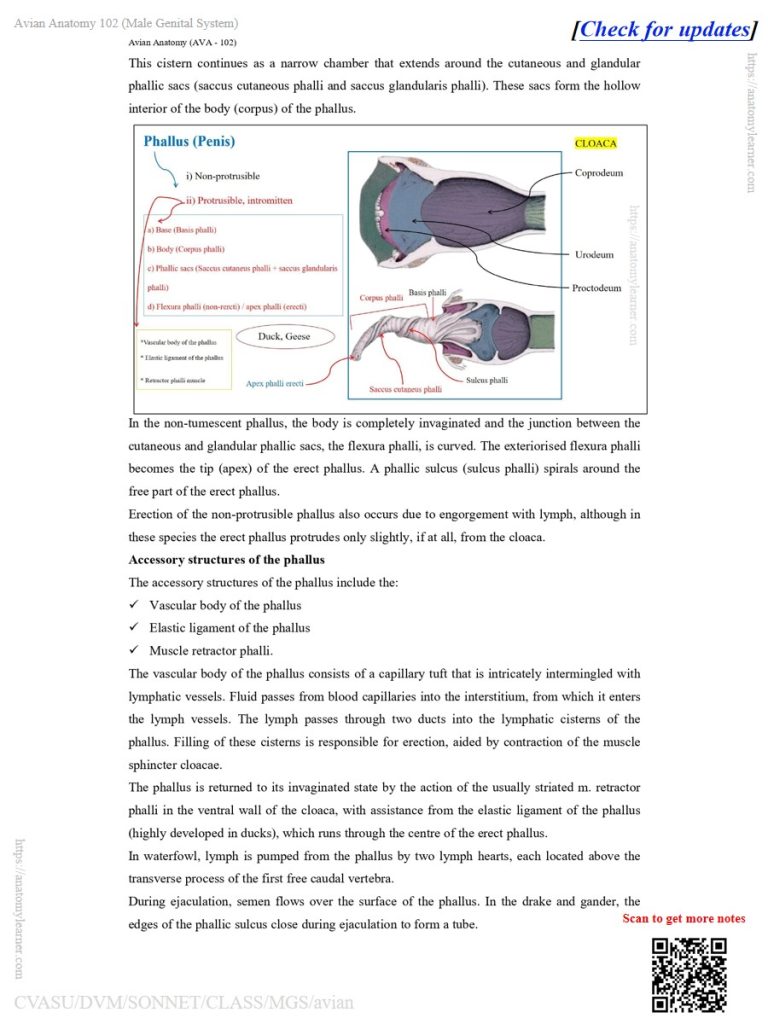
Now, let’s know which avian species have the protrusible phallus. Here, the ducks and geese are the best examples that have the protrusible phallus.
As the structure of the protrusible phallus is different from that of the non-protrusible phallus, you need to know the components. Here, the protrusible phallus of the avian male consists of the followings –
- Base (basis phalli),
- Body (corpus phalli),
- Phallic sacs (saccus cutaneus phalli and saccus glanularis phalli),
- Flexura phalli (non-erecti)/apex phalli (erecti).
You will find the description of all the above-mentioned structures or parts in the notes. However, first you need to identify these structures from the diagrams that provided in this article.
Accessory structures of the phallus
You also need to describe the accessory structure of the avian male’s phallus. Here, the accessory structures of the phallus consist of the followings –
- Vascular body of the phallus
- Elastic ligament of the phallus
- Muscle retractor phalli.
All three structures or parts of the accessory structures of the avian phallus are identified in the provided diagram. Thus, first try to identify these three structures and know the details from the provided notes.
NB. You will get the notes on the avian male reproductive system from the veterinary anatomy notes pages. The short overview of all the avian male reproductive organs might help you to memorize their main anatomical features.
Conclusion
So, the avian male reproductive system describes the anatomy of the oviduct, epididymis, ductus deferens, copulatory organ/phallus, and the accessory organs of the phallus. They are totally different in structure compared to the mammal’s male reproductive system.
Thus, it is your first duty to point out the special features of this system compared to mammals from the provided notes.
Author