
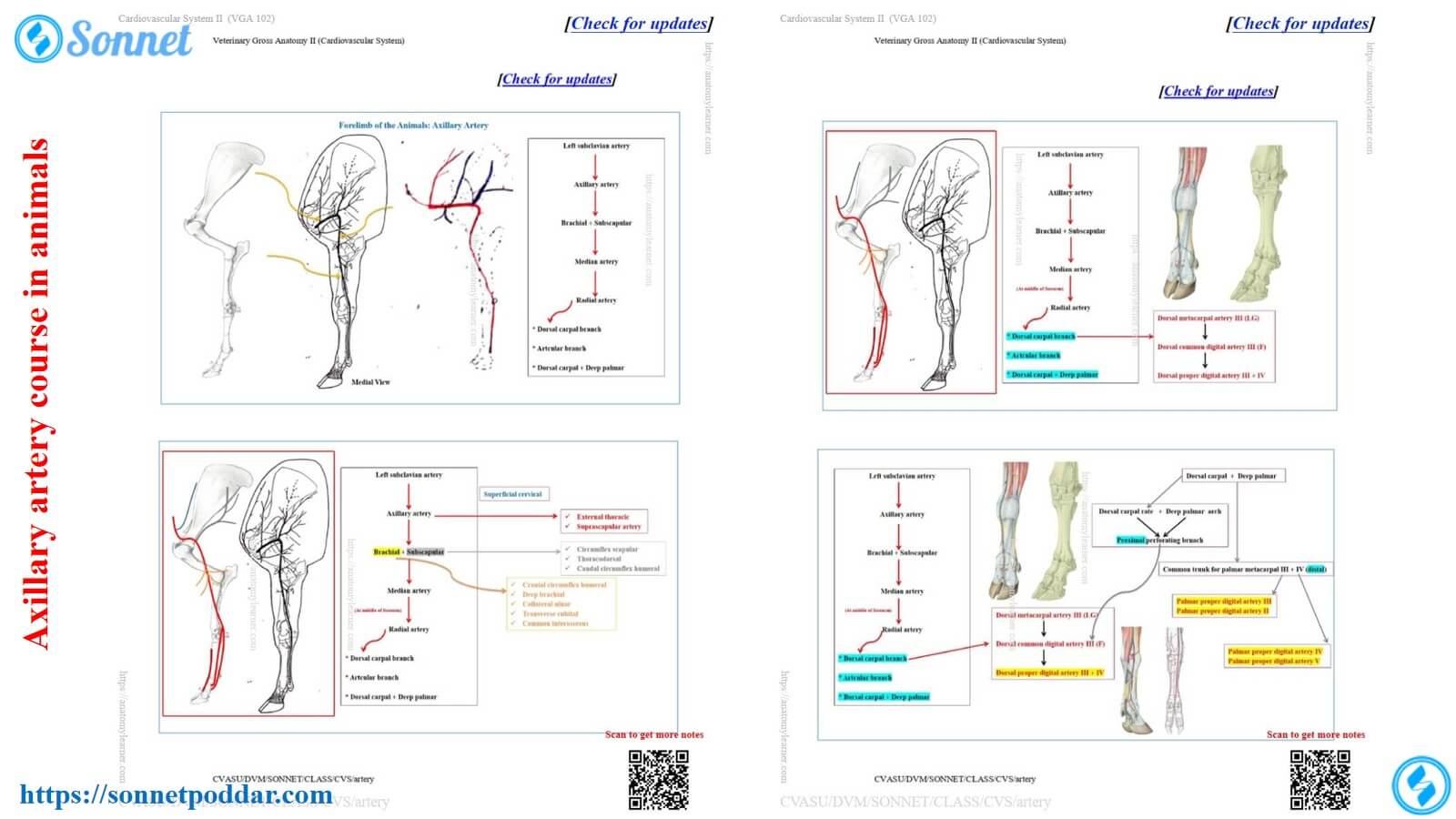
The axillary artery is the main arterial supply of the forelimb of animals (ox, goat, sheep). Here, I will discuss the summary of the courses of the axillary artery in different segments of the forelimb in ox, sheep, goat, and horse.
You will get a concise note on the animal’s axillary artery branches and courses. This note might help you to understand the complex courses more easily with sketch diagrams.
Axillary artery course in animals – ox, sheep, and goat
Origin of the axillary artery: Actually, the animal’s axillary artery arises from the brachiocephalic trunk. Here, the left one arises from the second intercostal space, whereas the right one arises at the level of the first rib.
The place of origin is different in various domestic animals. However, the name of the origin part is also different in various animals.
However, the subclavian artery continues as the axillary artery in most domestic animals.
Branches and course of the axillary artery in animals
The axillary artery of animals has different branches in their intrathoracic course. However, they leave the thoracic cavity and continue as the extrathoracic part of the axillary.
They give different branches in the various segments and parts of the animal’s forelimb.
Generally, you will find the following intrathoracic and extrathoracic branches of the animal’s axillary arteries in common –
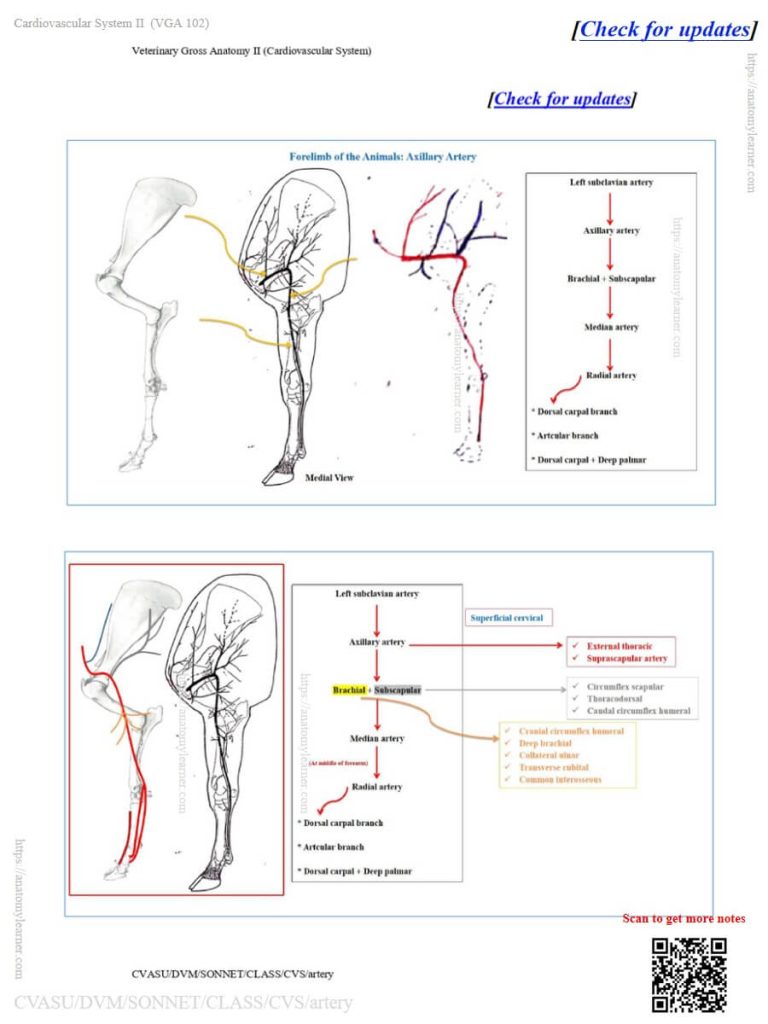
Intrathoracic branches of the axillary artery
- Costocervical artery,
- Superficial cervical artery, and
- Internal thoracic artery,
These are the main branches that have also sub-branches and supply different parts of the thorax.
Extrathoracic branches of the axillary artery
- External thoracic artery
- Suprascrapular artery
- Subscapular artery
- Cranial circumflex humeral artery,
- Deep brachial artery
- Collateral ulnar artery
- Transverse cubital artery
- Common interosseous artery,
- Radial and median artery,
These are also the main branches of the extrathoracic part of the animal’s axillary artery. They also have different sub-branches and supply different areas of the forelimb segments.
Thus, the course is complex, and you may go with the book that provides the details course of the axillary artery.
Important: But, here I will concise the main course of the axillary artery, so that you may identify the main branches practically. Before that, you might have deep knowledge of the different bones, segments, and a few muscles of the forelimb of specific animals like the ox, sheep, and goat.
NB. For a better understand, you may join my theory and practical classes where I have discussed details on the courses of the axillary artery. However, I have provided the techniques to memorize the courses of the axillary artery clearly.
Overview of the axillary artery course in ox, sheep, and goat
The first section of the provided diagram presents an overview of the concise courses of the axillary artery in ox, sheep, and goat.
You should only memorize these 5 main branches of the axillary artery (subclavian, axillary, brachial, median, and radial arteries). Then, you should follow the book or my classes and add the sub-branches to each of these main branches. That’s enough to learn the axillary artery, and you will easily identify these main branches from the live sample at the anatomy laboratory.
However, the distal branches of the median and radial artery is complex. For description purposes/to understand its basic – there are major three brnaches: dorsal carpal, articular branches, and dorsal carpal and deep palmar branches.
However, you will find different retes or arterial arches at the manus segment of the forelimb.
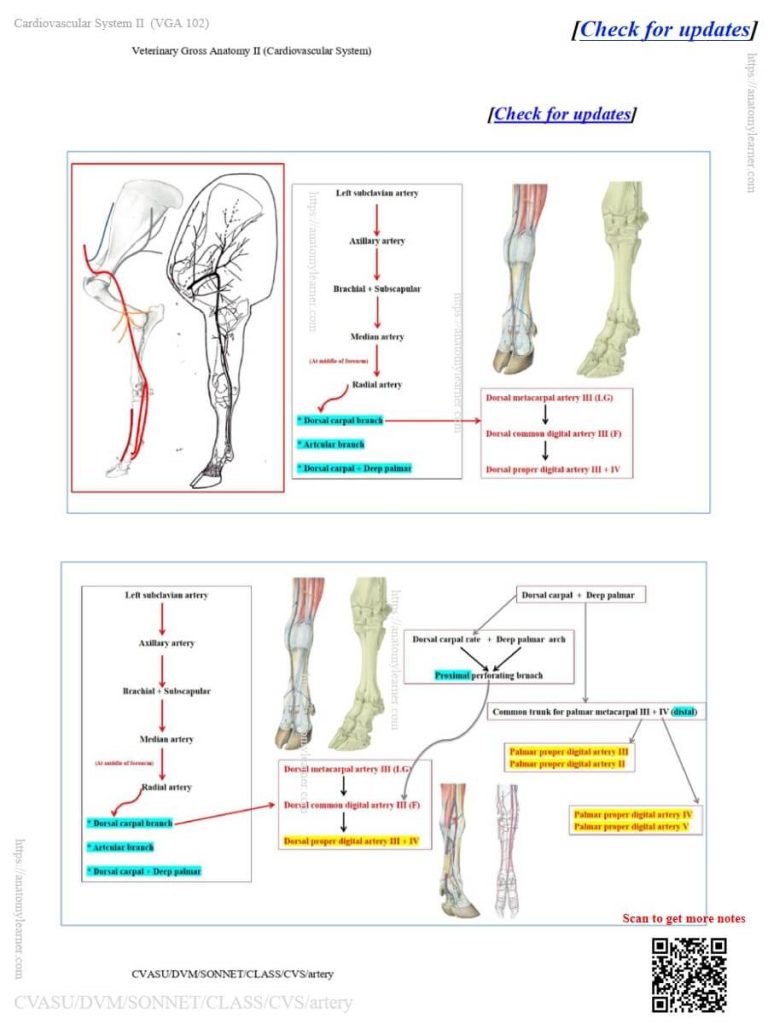
Distal branches of the axillary artery and digital supply
The dorsal carpal branches of the axillary artery provide the following branches –
Dorsal metacarpal artery III, Dorsal common digital artery III, and dorsal proper digital artery III.
However, the dorsal carpal rate and deep palmar arch provide the proximal perforating branches. Finally, it communicates with the dorsal common digital artery III and supplies digit III.
Again, the dorsal carpal and deep palmar form the common trunk for the palmar metacarpal III and IV. Finally, they form the four digital arteries to supply the digits II, III, IV, and V.
What are the common questions for the viva or theory examination?
Well, you will get the following theory questions in your final anatomy examination –
- Write down the branches and courses of the axillary artery of ox, sheep, or goat.
- Mention the distribution and supply the forelimb arteries in animals (ox/sheep/goat/dog)
However, the common viva questions on the axillary artery are like –
- How does the left or right axillary artery arise?
- Mention the location of the axillary artery in ox, goat, and sheep.
- Where is the brachial artery located in the ox’s forelimb?
- Mention the location of the median artery in the goat’s forelimb.
- Does the goat have the ulnar artery? It yes, where does it supply?
- How does the median artery supply the digits of a sheep and goat?
How to learn from the provided note on the axillary artery of the goat?
Well, first you need to read the theory and details of the course of the axillary artery of the goat from the book or other resources. Then, go with the concise note that I have provided with a different sketch diagram.
Main branches of the axillary artery are already marked in the diagram and note. Thus, try to memorize according to the segments of the bones. Sometimes, you need to memorize the muscles of the goat’s forelimb as the arteries run or supply them.
You should also practically visualize these branches of the axillary artery from the live sample.
FAQs on the axillary artery
Well, the axillary artery is found on the medial aspect of the shoulder and passes between the nerves of the brachial plexus.
After giving the superficial cervical branch from the subclavian and leaving the thoracic cavity, it becomes the axillary in the goat. Here, the axillary artery leaves the thoracic cavity through the thoracic inlet.
Conclusion
So, the axillary artery course in animals can be easily memorized through the provided notes. Make sure you add the sub-branches of the main branches of the axillary while writing for your theory examination.
The same axillary artery is termed the brachial, median or radial in different segments of the animal’s forelimb.
References
- Textbook of Veterinary Anatomy by Dyce, Sac, and Wensing
- Primary veterinary anatomy by RK Ghosh
- Comparative anatomy of the vertebrate by Kent and Carr
- Aydin et al., The morphology of the arteries originating from the arcus aorta and the branches of these arteries in mole-rats (Spalax leucodon). Veterinární medicína. 2013;58(7):373-376. doi: 10.17221/6918-VETMED.
- Ghoshal and Getty, The Arterial Supply to the Appendages of the Goat (Capra hircus).
Written by